
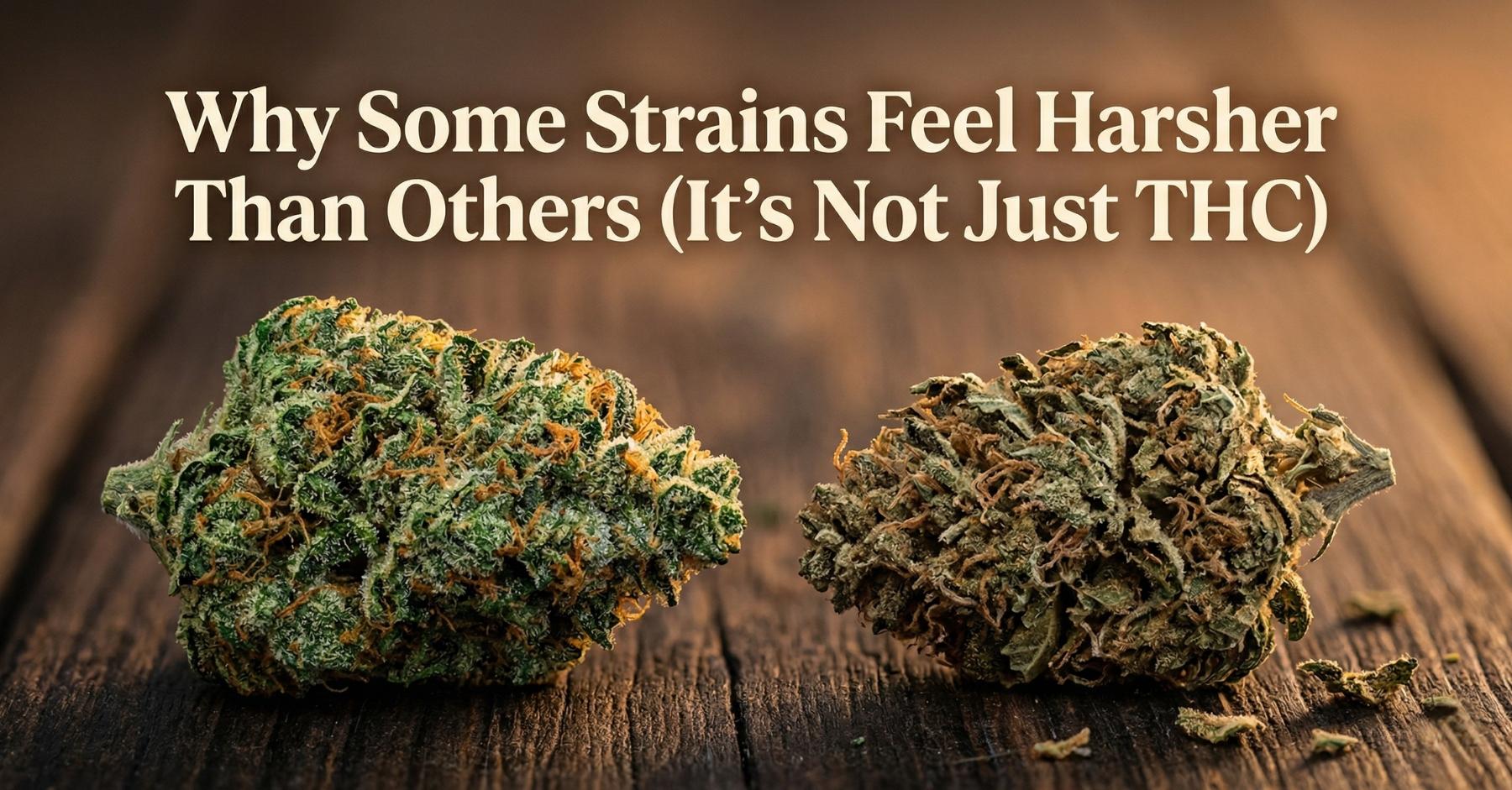
You've probably noticed it. One strain feels smooth and easy, almost gentle going down. Another one, sometimes from the same dispensary, sometimes even the same price point, hits your throat like sandpaper and leaves you coughing for thirty seconds.
Most people assume it's the THC. Higher percentage, harsher hit. Makes sense on the surface. But it's not that simple, and understanding what's actually happening can change the way you buy, store, and smoke your flower.
THC gets blamed for everything
Let's get this out of the way: THC percentage alone is not a reliable predictor of harshness. Plenty of high-THC strains smoke beautifully, and plenty of mid-range strains feel like they're scraping the inside of your throat.
THC does play a role. More potent flower can produce a heavier, denser smoke. But the burn, the scratch, the cough? That's usually coming from somewhere else entirely.
Terpenes: the flavor is also the feel
Every strain has a unique terpene profile, the combination of aromatic compounds that gives it a distinct smell and taste. But terpenes don't just affect flavor. They affect how the smoke feels in your throat and lungs.
Some terpenes produce a naturally smoother experience. Linalool, found in lavender, tends to create a floral, gentle sensation. Limonene, found in citrus, often feels bright and clean. Strains heavy in these terpenes tend to go down easier.
Others are more aggressive. Caryophyllene, found in black pepper, creates a spicy, peppery bite that some people find irritating. Humulene, found in hops, can add a dry, earthy heaviness. A strain loaded with these terpenes might feel noticeably rougher, even at a lower THC percentage.
This is why two strains at the exact same potency can feel completely different in your throat. The terpene profile is doing more work than most people give it credit for.
How it was grown matters more than most people realize
Even with the right genetics, the way a plant was cultivated has a massive impact on harshness.
Nutrient flushing, or the lack of it, is one of the biggest factors. Before harvest, growers are supposed to feed the plant only plain water for a week or two. This flushes out residual salts, minerals, and fertilizers stored in the plant tissue. When that step is rushed or skipped (and it often is, especially in high-volume operations), those compounds end up in the flower. When you light them, they burn hot and harsh, producing a sharp, metallic, chemical-tinged taste that has nothing to do with the strain itself.
Pesticide and spray residue is another culprit. Even organic pesticides like neem oil can leave behind compounds that alter the taste and harshness of the smoke. In legal markets with testing requirements, this is less of a concern, but it hasn't been eliminated.
And then there's something most people never think about: sugar leaves. These are the small leaves closest to the bud, often coated in trichomes. Some growers leave them on because they add weight and visual frostiness. But they burn hotter and harsher than the flower itself, and they can make an otherwise smooth strain feel rough.
Curing is where smooth smoke is made (or lost)
This is the factor that probably affects harshness more than any other, and it's the one consumers have the least visibility into.
After harvest, cannabis needs to be dried slowly and then cured, sealed in containers and allowed to age, typically for several weeks. Curing does two critical things: it lets residual moisture equalize through the bud, and it allows chlorophyll and sugars to break down. If those compounds are still present when you light up, they burn hot and taste like hay.
Good curing also allows terpenes to mature and develop complexity. Rushed curing produces flat, one-dimensional, harsh smoke. Patient curing produces layered, flavorful, smooth smoke, even from strains that are genetically predisposed to be a bit rough.
The problem is that curing takes time, and time costs money. Commercial growers under pressure to move product quickly often cut the curing process short. That means even premium flower from a reputable dispensary can sometimes smoke harsher than it should.
Moisture: the Goldilocks problem
Cannabis that's too dry smokes harsh. Cannabis that's too wet smokes harsh. The sweet spot is a moisture content around 8-10%.
Flower below that range has lost the moisture that naturally tempers the heat of combustion. Every hit feels scratchy and thin. The terpenes have likely evaporated too, so there's no flavor to compensate. If your flower crumbles to dust when you break it apart, you're below the line.
Flower above that range doesn't burn evenly, which creates pockets of incomplete combustion. Some areas burn hot while others barely ignite. That inconsistency produces extra irritation and an unpleasant taste. If your flower feels spongy or doesn't grind cleanly, it's probably too moist.
Proper storage makes a real difference here. Airtight glass containers, kept in a cool dark place, with a humidity control pack if you want to be precise. Plastic bags and direct sunlight are the fastest way to ruin a perfectly good batch.
Age: flower has a shelf life
Cannabis doesn't expire like food, but it absolutely degrades. After about six months, even with proper storage, terpenes begin to break down. THC slowly converts to CBN (which makes you sleepy but doesn't deliver the same effects), and the overall smoking experience gets harsher and flatter.
If a strain felt great when you bought it but feels rough three months later, the flower might simply be past its prime. Harshness can be a sign of degradation, not a flaw in the strain itself.
What you can actually control
Here's the reality: you can't control how your flower was grown, flushed, or cured. You can't always know the terpene profile before you buy. And you can't reverse degradation once it's happened.
But you can control what happens between the flower and your lungs.
How smoke travels through your setup, the temperature it reaches, the particles it carries, the path it takes, has a direct effect on how harsh any strain feels. A strain that hits rough through a cheap glass pipe or rolled paper might feel noticeably smoother through a system designed to cool and filter the smoke before it reaches your throat.
That's the concept behind products like the Maze-X Pipe, which forces smoke through a 14-inch cooling pathway inside a 5.5-inch body. By the time it reaches your throat, the temperature has dropped and a significant amount of tar and hot resin particles have been left behind in the maze. It doesn't change the strain. It changes what reaches your lungs.
Adding a Carbon-X activated carbon filter takes it further, trapping combustion byproducts at the molecular level while letting cannabinoids and terpenes pass through. This works in the Maze-X, the X7 and X5 one-hitters, or for pre-roll smokers, it's already built into Smoovs cones.
You might not be able to control the cure. But you can absolutely control the last few inches of the smoke's journey.
The real takeaway
When a strain feels harsh, the instinct is to blame the flower. And sometimes the flower is the problem: bad cure, old stock, aggressive terpene profile.
But more often, the harshness is a combination of factors. The one you have the most power over is the thing you're smoking from. A better setup won't turn bad flower into good flower. But it will reveal whether the harshness was the strain, or your gear making every strain feel worse than it needs to.
Weedgets products are designed to reduce harshness regardless of strain. Carbon-X activated carbon filters are compatible with the Maze-X Pipe, X7 One-Hitter, and X5 One-Hitter. Smoovs pre-roll cones include integrated Carbon-X filtration built in.
SHOP THIS BLOG
See what people are saying!
"The best cannabis delivery device! I have spent thousands of dollars on various cannabis delivery devices for the many different forms available today. This incredible device provides the smoothest smoke with the most efficient burn leading to most pleasant buzz. No other device or type is needed. They are all a waste of time and money. The maze X is the only device a cannabis user will ever need."
— John H., Weedgets Customer
"Best little 'whatchamacallit' in recent history. I bought the starter kit and I gotta say, the small and medium are just incredible. The small one works great with regular joints. I have been experimenting with cannagars recently and have been making 'cigarillo' sized cannagers and the medium tip is just the perfect size for it. I plan to start making fatter cannagars shortly and I believe the large will be just right for the largers sized ones. The extra large, I'm not quite sure I'll find a need for it as it is really quite large. I assume, as the pictures show, that the extra large tip would work great on some pipes and possibly small bongs. Really a great little gizmo."
— Murray G., Weedgets Customer
"A Solid Piece of Smoking Equipment! I have truly enjoyed using my new Maze-X Pipe. It is such a solid piece of smoking equipment, so well thought out and well put together. It has it all...easy to use...easy to clean...no tiny, little replacement parts that become instantly lost. I was so impressed, I just bought another Maze-X for a present!"
— D.G., Weedgets Customer
"GOAT pipe. Been smoking 50 years. I have asthma & have struggled nearly the whole time 2 get decent hit without choking up. UNTIL I bought the Maze X. I can finally enjoy a bowl. THANK YOU WEEDGETS 4 THE GOAT PIPE.😎"
— Katie S., Weedgets Customer
Join the CLUB for new videos, discount codes, and more!