
You've probably heard that activated carbon filters "trap harmful compounds" or "filter out tar and toxins." And if you use Carbon-X filters in your pipe, you've probably felt the difference firsthand. Smoother hits, less coughing, less throat burn.
But what's actually happening inside that tiny filter? What is it doing to the smoke at a level you can't see, and why does it work so much better than water, screens, or just a longer pipe?
The answer is surprisingly elegant. And once you understand it, you'll never look at that little filter the same way again.
First: activated carbon is not regular charcoal
This is the most common misconception. People hear "carbon filter" and picture a charcoal briquette. Same stuff you throw on a grill. And they wonder how that could possibly be doing anything meaningful to smoke.
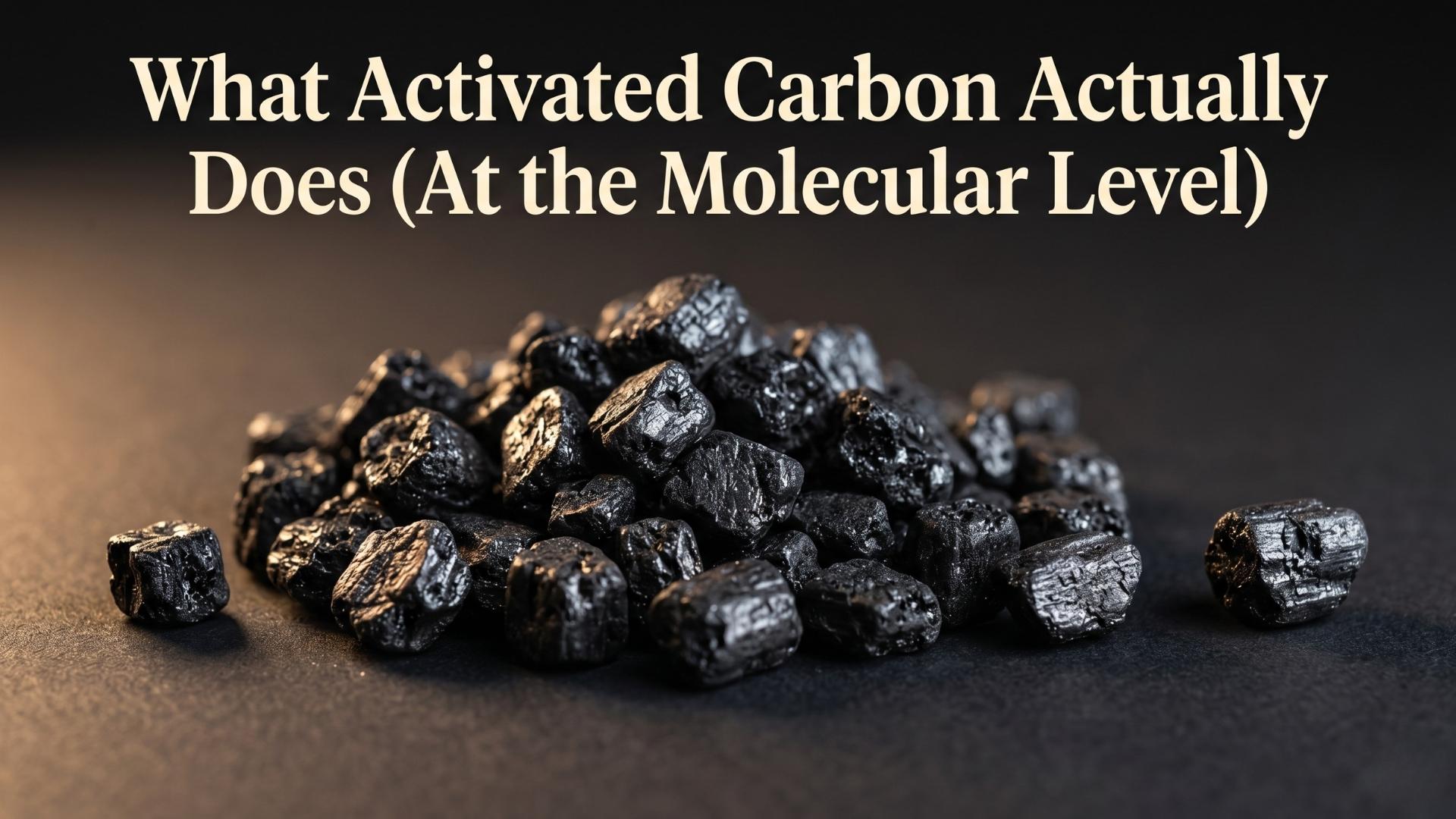
Activated carbon starts as carbon-rich material, usually coconut shells, wood, or coal. But then it goes through a process called activation, where it's heated to extreme temperatures (800 to 1,000 degrees Celsius) in the presence of steam or specific chemical agents. That process doesn't just burn the material. It fundamentally restructures it at the molecular level, carving out millions of microscopic tunnels, chambers, and pores throughout the interior of each grain.
The result is a material that looks solid on the outside but is incredibly porous on the inside. Imagine a tiny sponge, except instead of big visible holes, the "holes" are measured in nanometers (billionths of a meter) and there are millions of them per grain.
This is what makes activated carbon different from charcoal. Charcoal has some porosity, but activated carbon has been engineered to maximize internal surface area to an almost absurd degree.
The surface area number that changes everything
Here's the stat that makes activated carbon remarkable: a single gram of properly activated carbon can have an internal surface area of 1,000 to 1,500 square meters. That's roughly the size of four tennis courts, packed into something that weighs less than a paperclip.
Let that sink in. A Carbon-X filter small enough to fit inside a pipe contains a material where every single gram has the internal surface area of four tennis courts. That's not marketing language. That's measured physics.
All of that surface area is where the filtration happens. And the way it happens is through a process that most people have never heard of, even though it's used in everything from water treatment plants to hospital air purifiers to gas masks.
Adsorption: the mechanism that makes it work
The word is adsorption, not absorption. The difference matters.
Absorption is what a sponge does. Liquid soaks into the material and fills up the space inside. The liquid is just sitting in there, held by physical space.
Adsorption is fundamentally different. In adsorption, molecules from the smoke physically bind to the surface of the carbon. They stick to it at the molecular level through attractive forces called Van der Waals forces, the same weak electromagnetic forces that allow geckos to walk on ceilings.
When smoke passes through activated carbon, the compounds in that smoke enter the vast network of internal pores. As they travel through the tunnels, the molecules of harmful compounds (tar, resin particles, many combustion byproducts) are attracted to the carbon walls and physically bind to them. They don't just get "caught" like particles in a net. They chemically adhere to the surface and stay there.
The carbon essentially grabs the harmful molecules and holds onto them while allowing other molecules to pass through.
Why it catches the bad stuff but not the good stuff
This is the question everyone asks, and the answer is what makes activated carbon so much more useful than water filtration or mechanical screens.
Activated carbon is selective. Not all molecules bind to it equally.
The pores inside activated carbon come in three sizes. Macropores (the largest) act as highways, channeling smoke deep into the carbon's interior. Mesopores (mid-sized) capture larger organic molecules. Micropores (the smallest, less than 2 nanometers wide) trap the smallest compounds, including gases and lightweight toxic molecules.
The compounds you don't want in your smoke, things like tar, polycyclic aromatic hydrocarbons (the cancer-linked compounds produced by combustion), volatile organic compounds, and fine resin particles, tend to be the right size and molecular structure to be captured by these pores. They bind readily to the carbon surface because of their chemical properties.
The compounds you do want, primarily cannabinoids like THC and CBD, along with terpenes, have different molecular characteristics. They're structured differently, they interact with the carbon surface differently, and they pass through the pore network with minimal binding. They continue through the filter and into your lungs, essentially unchanged.
This is why filtered smoke still gets you high and still tastes like the strain you're smoking. The filter isn't stripping everything out of the smoke indiscriminately. It's selectively removing the harsh compounds while leaving the cannabinoids and terpenes largely intact.
No other common filtration method does this. Water catches some irritants but also traps cannabinoids and terpenes (often proportionally more of them than the harmful stuff). Screens catch large particles but do nothing about tar, gases, or combustion byproducts. A longer pipe cools the smoke slightly but doesn't remove any compounds at all. Activated carbon is the only widely available material that selectively targets the harmful components of smoke while preserving the ones you actually want.
What happens inside the filter during a session
Picture this at a molecular level.
You light your bowl and draw. Smoke enters the pipe, travels through the body, and reaches the Carbon-X filter. The smoke is a complex mixture of hundreds of compounds: cannabinoids, terpenes, tar, carbon monoxide, fine ash particles, resin droplets, and dozens of combustion byproducts.
As the smoke passes through the activated carbon, it enters the pore network. Tar molecules, which are large and sticky, bind to the mesopore and micropore walls almost immediately. Volatile organic compounds and smaller toxic molecules are drawn into the micropores, where they adhere to the carbon surface through Van der Waals forces. Fine resin particles get physically trapped in the pore structure.
Meanwhile, THC, CBD, and terpene molecules navigate through the pore network without binding significantly. They exit the other side of the filter and continue to your lungs, where absorption into your bloodstream happens normally.
The whole process takes a fraction of a second. You don't feel the filter "working." You just notice that the hit is smoother, the taste is cleaner, and the cough that usually comes with it doesn't.
Why the filter eventually needs replacing
Every filter has a finite capacity. Each time smoke passes through, more harmful molecules bind to the carbon surface. Over time, the available binding sites fill up. Once enough of the surface area is occupied, the filter becomes less effective at capturing new compounds because there's simply no room left for them to adhere.
This is why activated carbon filters need to be replaced regularly, not cleaned. You can't wash the adsorbed molecules off the carbon surface. They're chemically bound. The filter has done its job, and it needs to be swapped for a fresh one.
With Carbon-X filters, the replacement cycle depends on how frequently you smoke and how heavily. But the general rule is simple: when you start noticing the harshness creeping back in, the filter has reached capacity and it's time for a new one.
Where else activated carbon is trusted
If activated carbon filtration sounds like it's too simple to be effective, consider where else it's used.
Municipal water treatment plants use it to remove pesticides, chlorine, and organic pollutants from drinking water. Hospitals use it in air purification systems to remove airborne contaminants. Military gas masks use it to protect soldiers from chemical and biological agents. Kidney dialysis machines use it to purify blood. Emergency rooms use it (in liquid form) to treat poisoning and drug overdoses.
This is not a niche or experimental technology. It's one of the most well-studied, well-proven filtration materials on earth, used in life-critical applications where failure isn't an option. Applying it to cannabis smoke filtration is, if anything, a surprisingly obvious use case that took longer to arrive than it should have.
The bottom line
Activated carbon filtration isn't a gimmick or a marginal improvement. It's a well-understood science that works at the molecular level to selectively remove the compounds in smoke that cause harshness, coughing, throat burn, and long-term respiratory irritation, while allowing the cannabinoids and terpenes you actually want to pass through essentially unchanged.
Every gram of the material contains the internal surface area of four tennis courts. Every pore is a tiny trap designed to grab harmful molecules and hold onto them. And every session through a fresh filter is measurably cleaner than an unfiltered one.
It's the same technology trusted to purify drinking water, protect soldiers, and save lives in emergency rooms. The fact that it also makes your evening session smoother is almost an afterthought.
Carbon-X activated carbon filters are compatible with the Maze-X Pipe, X7 One-Hitter, and X5 One-Hitter. Smoovs pre-roll cones include integrated Carbon-X filtration built in.
SHOP THIS BLOG
Activated Carbon Filters
Smoovs Pre-Roll Cones
Toke & Lock Stash Bag
See what people are saying!
"The best cannabis delivery device! I have spent thousands of dollars on various cannabis delivery devices for the many different forms available today. This incredible device provides the smoothest smoke with the most efficient burn leading to most pleasant buzz. No other device or type is needed. They are all a waste of time and money. The maze X is the only device a cannabis user will ever need."
— John H., Weedgets Customer
"Best little 'whatchamacallit' in recent history. I bought the starter kit and I gotta say, the small and medium are just incredible. The small one works great with regular joints. I have been experimenting with cannagars recently and have been making 'cigarillo' sized cannagers and the medium tip is just the perfect size for it. I plan to start making fatter cannagars shortly and I believe the large will be just right for the largers sized ones. The extra large, I'm not quite sure I'll find a need for it as it is really quite large. I assume, as the pictures show, that the extra large tip would work great on some pipes and possibly small bongs. Really a great little gizmo."
— Murray G., Weedgets Customer
"A Solid Piece of Smoking Equipment! I have truly enjoyed using my new Maze-X Pipe. It is such a solid piece of smoking equipment, so well thought out and well put together. It has it all...easy to use...easy to clean...no tiny, little replacement parts that become instantly lost. I was so impressed, I just bought another Maze-X for a present!"
— D.G., Weedgets Customer
"GOAT pipe. Been smoking 50 years. I have asthma & have struggled nearly the whole time 2 get decent hit without choking up. UNTIL I bought the Maze X. I can finally enjoy a bowl. THANK YOU WEEDGETS 4 THE GOAT PIPE.😎"
— Katie S., Weedgets Customer
Join the CLUB for new videos, discount codes, and more!