
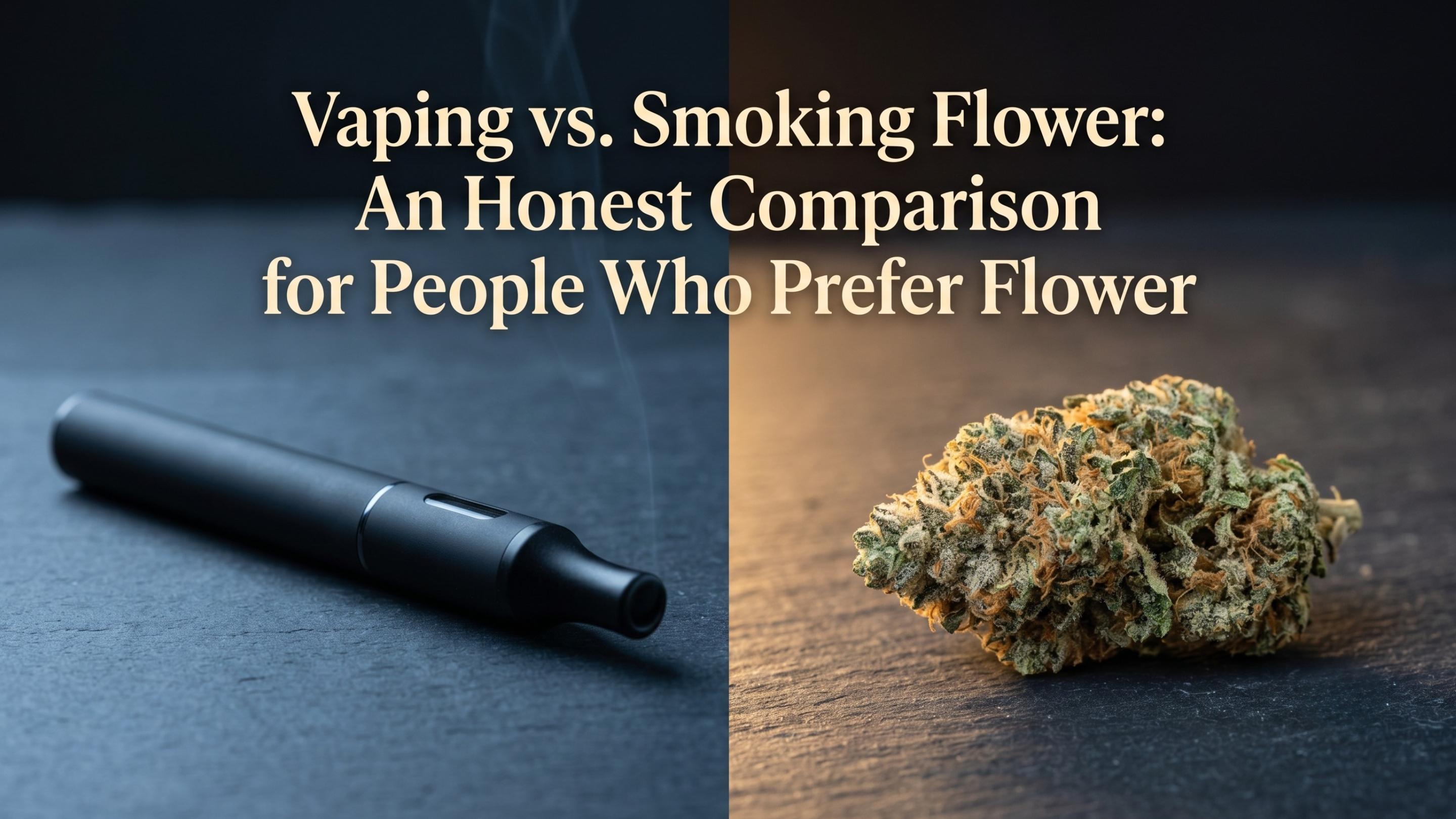
If you prefer smoking flower, you've probably been told you should switch to vaping. It's "cleaner." It's "healthier." It's "the modern way." The implication is always the same: smoking is outdated and vaping is the upgrade.
But is it?
The honest answer is more complicated than either side wants to admit, and the emerging science is starting to paint a picture that should make anyone who vapes cannabis stop and pay attention. Because the risks of vaping aren't just "not as low as people think." In several important ways, they may be worse than what most people realize.
Here's what the research actually says, written for someone who just wants to understand what they're putting in their body.
The assumption that got everyone here
The entire case for cannabis vaping rests on one idea: no combustion means no harmful byproducts. Since vaping heats cannabis oil or flower to a temperature below the point of combustion, it produces vapor instead of smoke. No burning means no tar, no carbon monoxide, no ash. Cleaner in, cleaner out.
That logic sounds airtight. And for years, it was basically accepted as fact by consumers, dispensaries, and even some health professionals. Vaping was treated as the obvious harm reduction choice.
The problem is that the science never actually confirmed this. The assumption was based on the absence of combustion, not on evidence that vaping was safe. Those are very different things. And now that researchers have started looking closely at what's actually in cannabis vapor, the results are not what anyone expected.
What's actually in the vapor
In 2025, researchers at McGill University published two studies examining what cannabis vapor does to human lung cells. Their findings were blunt: cannabis vapor contains toxic, carcinogenic, and teratogenic (birth-defect-causing) substances. Both cannabis smoke and cannabis vapor triggered gene expression changes in lung cells linked to cancer, cellular stress, and immune system disruption.
The lead researcher, Dr. Carolyn Baglole, put it plainly: cannabis vapor, like cannabis and tobacco smoke, contains toxic substances that may increase the risk of health problems in regular users. The assumption that vaping avoids these risks simply because there's no visible combustion turned out to be wrong.
A separate study published in the American Journal of Physiology compared cannabis smoke and cannabis vapor side by side using identical flower. Both produced compounds that triggered inflammatory pathways, oxidative stress responses, and changes in gene expression associated with cancer development in bronchial cells. The vapor was not meaningfully "cleaner" than the smoke at the cellular level.
This doesn't mean vaping and smoking are identical. But the gap between them is far smaller than consumers have been led to believe, and in some areas, vaping introduces risks that smoking flower doesn't.
The heavy metals problem
Here's where vaping starts to look genuinely worse than smoking flower, not just comparable.
Cannabis vape cartridges are made of metallic and non-metallic components: heating coils, metal housings, solder joints, and wiring. When the heating element activates, it doesn't just vaporize the cannabis oil. It also causes metals from the device itself to leach into the vapor you're inhaling.
A 2025 scoping review published in Scientific World Journal analyzed data from nine studies on heavy metals in cannabis vape products. The findings were consistent across all of them: metals including nickel, chromium, lead, cobalt, cadmium, and copper were detected in both the vape liquids and the aerosols produced by the devices. These metals were being transported into the vapor as tiny particles and inhaled directly into users' lungs.
The mechanism is straightforward. The heating coil reaches temperatures between 200 and 600 degrees Celsius. At those temperatures, metal components of the cartridge begin to dissolve into the cannabis oil. The hotter the device runs and the longer it operates, the more metal leaches into the liquid. Older cartridges leach more than new ones. Cartridges stored at higher temperatures leach more than those stored cool. And when liquid levels get low, the exposed heating coil gets even hotter, accelerating the process further.
A Health Canada study found that some unregulated cannabis vape cartridges contained 100 times more lead than regulated products, far exceeding accepted tolerance limits. But even regulated products showed detectable levels of metals in the vapor. The contamination wasn't limited to cheap knockoffs. It was a feature of the device design itself.
When you smoke flower, you're not inhaling heated metal. The combustion byproducts from flower are real and worth addressing (more on that below), but heavy metal inhalation is not one of them. This is a risk that belongs exclusively to vaping.
The EVALI crisis: what it revealed
In the summer of 2019, a wave of mysterious lung injuries swept across the United States. Thousands of people, many of them young and previously healthy, showed up at emergency rooms with severe respiratory damage. The condition was eventually named EVALI (e-cigarette or vaping product use-associated lung injury).
By the time the outbreak subsided in early 2020, more than 2,800 people had been hospitalized and 68 had died. The cause was eventually traced to vitamin E acetate, a thickening agent that black market producers were adding to THC vape cartridges to stretch their supply. The substance coated the inside of users' lungs and triggered a severe inflammatory response.
The EVALI crisis exposed something fundamental about vaping that flower smoking doesn't share: when you vape, you're not just consuming cannabis. You're consuming whatever else is in the cartridge, and you often have no way of knowing what that is. The oil, the thinning agents, the flavoring compounds, the residual solvents from extraction, the metals from the hardware. All of it gets vaporized and inhaled.
With flower, what you see is what you get. It's a plant. You can look at it, smell it, test it. The supply chain is short and transparent. With vape cartridges, the supply chain is long, opaque, and filled with opportunities for contamination at every step.
Concentrate potency: a hidden problem
Cannabis vape cartridges typically contain concentrated THC oil. While average flower contains roughly 17-22% THC, vape concentrates routinely reach 80-95% THC. That's not a small difference. It's a fundamentally different substance.
Research from Johns Hopkins found that vaping cannabis produced significantly stronger effects than smoking the same dose of flower, including higher rates of short-term anxiety, paranoia, memory impairment, and distraction, particularly in infrequent users. The researchers specifically warned that the higher THC delivery from vaping increases the likelihood of adverse reactions.
For older smokers especially, this potency issue matters. The body processes concentrated THC differently than it processes moderate-potency flower. The rapid onset, the intensity of the high, and the cognitive side effects are all amplified. Many older users who switch to vaping find the experience uncomfortably intense compared to the familiar, controllable experience of smoking flower.
What smoking flower actually looks like (honestly)
None of this means smoking flower is harmless. Combustion produces real byproducts that affect your respiratory system: tar, carbon monoxide, hot particles, and dozens of other compounds. These are facts, not scare tactics.
But here's what smoking flower doesn't involve:
It doesn't involve inhaling heated heavy metals from device hardware. It doesn't involve mystery additives, cutting agents, or residual solvents. It doesn't involve concentrated THC at levels 4 to 5 times higher than the plant naturally produces. And it doesn't involve a supply chain where contamination can be introduced at extraction, formulation, filling, or packaging stages without the consumer ever knowing.
The risks of smoking flower are well-understood, well-documented, and, critically, addressable. The harshness, the cough, the tar, the hot particles — these are real problems with real solutions that don't require switching to a different consumption method entirely.
Making flower smoking meaningfully better
The science on reducing harm from smoking flower is actually quite strong, and it centers on two things: cooling the smoke and filtering it before it reaches your lungs.
Activated carbon filtration is one of the most effective tools available. Activated carbon traps tar, resin particles, and many combustion byproducts through a process called adsorption, where harmful compounds physically bind to the carbon's surface as smoke passes through. The cannabinoids and terpenes you want pass through with minimal loss. You keep the experience. You lose the harshness.
Engineered cooling pathways address the temperature problem. When smoke is forced to travel through a long, winding channel before reaching your throat, it loses significant heat along the way. Cooler smoke means less irritation, less coughing, and less damage to the soft tissue in your throat.
Products like the Maze-X Pipe combine both approaches. Smoke travels through a 14-inch patented maze pathway inside a 5.5-inch body, cooling as it goes while tar and hot particles drop out along the way. Adding a Carbon-X activated carbon filter takes the filtration further, trapping combustion byproducts at the molecular level. The X7 and X5 one-hitters use the same Carbon-X compatibility. And for pre-roll smokers, Smoovs cones come with Carbon-X filtration built into the cone itself.
The point isn't that smoking is risk-free. It isn't. The point is that the risks of smoking flower can be meaningfully reduced through better engineering, without switching to a consumption method that introduces an entirely different (and in some ways more concerning) set of risks.
The bottom line
The narrative that vaping is automatically safer than smoking was always based more on assumption than evidence. As the research catches up, the picture is getting more complicated, not less.
Vaping introduces heavy metal exposure from device hardware. It introduces supply chain risks that don't exist with whole flower. It delivers THC at concentrations far beyond what the plant naturally produces. And the long-term effects are still largely unknown because the products simply haven't existed long enough to study.
Smoking flower has its own risks. But those risks are well-understood, and the tools to reduce them already exist.
If you prefer flower, you don't need to apologize for it. You don't need to switch to something that trades one set of risks for another. You just need a setup that addresses the known issues with combustion and lets you enjoy the experience the way you want to, with less harshness, less cough, and fewer harmful compounds reaching your lungs.
The flower isn't the problem. The setup is the solution.
Carbon-X activated carbon filters are compatible with the Maze-X Pipe, X7 One-Hitter, and X5 One-Hitter. Smoovs pre-roll cones include integrated Carbon-X filtration built in. The Maze-X Pipe is officially endorsed by the American Cannabis Nurses Association.
SHOP THIS BLOG
See what people are saying!
"The best cannabis delivery device! I have spent thousands of dollars on various cannabis delivery devices for the many different forms available today. This incredible device provides the smoothest smoke with the most efficient burn leading to most pleasant buzz. No other device or type is needed. They are all a waste of time and money. The maze X is the only device a cannabis user will ever need."
— John H., Weedgets Customer
"Best little 'whatchamacallit' in recent history. I bought the starter kit and I gotta say, the small and medium are just incredible. The small one works great with regular joints. I have been experimenting with cannagars recently and have been making 'cigarillo' sized cannagers and the medium tip is just the perfect size for it. I plan to start making fatter cannagars shortly and I believe the large will be just right for the largers sized ones. The extra large, I'm not quite sure I'll find a need for it as it is really quite large. I assume, as the pictures show, that the extra large tip would work great on some pipes and possibly small bongs. Really a great little gizmo."
— Murray G., Weedgets Customer
"A Solid Piece of Smoking Equipment! I have truly enjoyed using my new Maze-X Pipe. It is such a solid piece of smoking equipment, so well thought out and well put together. It has it all...easy to use...easy to clean...no tiny, little replacement parts that become instantly lost. I was so impressed, I just bought another Maze-X for a present!"
— D.G., Weedgets Customer
"GOAT pipe. Been smoking 50 years. I have asthma & have struggled nearly the whole time 2 get decent hit without choking up. UNTIL I bought the Maze X. I can finally enjoy a bowl. THANK YOU WEEDGETS 4 THE GOAT PIPE.😎"
— Katie S., Weedgets Customer
Join the CLUB for new videos, discount codes, and more!